Deck railings have two jobs: keep everyone on the deck and look good doing it. The best deck railing ideas for Oklahoma homes manage both with a material that suits your sun exposure, your budget, and your patience for upkeep, whether that’s wood, aluminum, composite, cable, glass, or a wood-and-metal mix. At Tiller Fence and Deck in Norman, we build deck railings across the Oklahoma City metro, and we’ve seen which ones still look good after a few Oklahoma summers.
Choosing one sounds simple until our weather bakes the deck one day and sends a thunderstorm through the next. This guide compares how each option looks, what it costs relative to the others, and how much care it needs, plus the safety rules every railing has to meet.
Popular Deck Railing Options for Oklahoma Homes
The right railing can change the whole look of your outdoor space. Some homeowners love the warmth of natural wood, while others want clean lines, open views, and minimal upkeep. Before you settle on a railing design, think about how each material handles our weather, how much maintenance you’ll really do, and whether it suits your home’s architecture. Here’s how the common railing materials compare at a glance.
| Material | Best For | Upkeep | Relative Cost |
|---|---|---|---|
| Wood | Classic look, tight budgets | High | Lowest |
| Aluminum | Modern style, no rust | Low | Mid to higher |
| Composite | Wood look, less work | Low | Mid-range |
| Vinyl | Lowest upkeep | Low | Varies |
| Cable | Open views | Moderate | Higher |
| Glass | Unobstructed views | Moderate | Highest |
| Iron and steel | Decorative detail | Moderate | Varies |
The cost column reflects typical relative pricing: wood is usually the least expensive option, composite sits in the middle, and cable systems and glass sit at the top. Actual railing costs depend on the length of the run, the number of corners and stairs, and the product line you choose. There’s no single winner for every deck, which is why the sections below spend as much time on limitations as on looks.
Wood Railing: A Traditional Look at the Lowest Starting Cost
There’s something about a traditional wood railing that feels right on a backyard deck. It brings warmth and character, and its classic design suits farmhouse, rustic, and ranch-style homes, which cover a lot of Oklahoma. Wood posts, top and bottom rails, and vertical balusters make up the familiar deck railing most of us grew up leaning on.
Pressure-treated pine is the usual budget pick, and cedar costs more but offers a richer color and a smoother finish. You can dress up either one with turned balusters, decorative post caps, or a painted finish that matches your porch railings and trim. Wood is also the easiest material to repair, since you can swap out a cracked baluster without replacing a whole section.
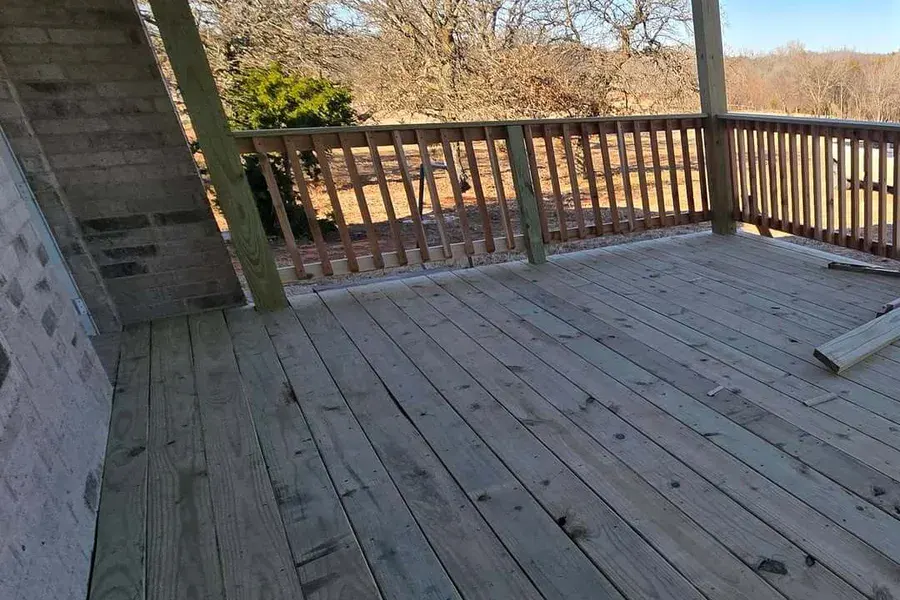
The trade-off is upkeep. Our sun dries wood out, and our spring rains soak it right back, so a wood railing needs cleaning plus stain or sealer on a regular schedule to hold off cracking, graying, and rot. If you don’t mind a weekend of maintenance every so often, wood remains a durable option with plenty of personality, and our guide on how long a wood deck lasts covers the care routine in more detail.
Aluminum Railing: Modern Looks With Minimal Maintenance
If spending a Saturday staining deck railings sounds about as appealing as mowing the lawn twice, aluminum railing deserves a look. Aluminum is lightweight, doesn’t rust, and comes in multiple colors and profiles. Powder-coated aluminum is the most common choice because the baked-on finish holds its color well with very little upkeep.
Textured black railings create a sharp contrast against wood or composite decking, while white and bronze finishes suit more traditional architectural styles. Many aluminum systems ship as pre-assembled panels, which keeps the lines consistent and makes for a more straightforward installation. An occasional wash is usually all the care it needs.
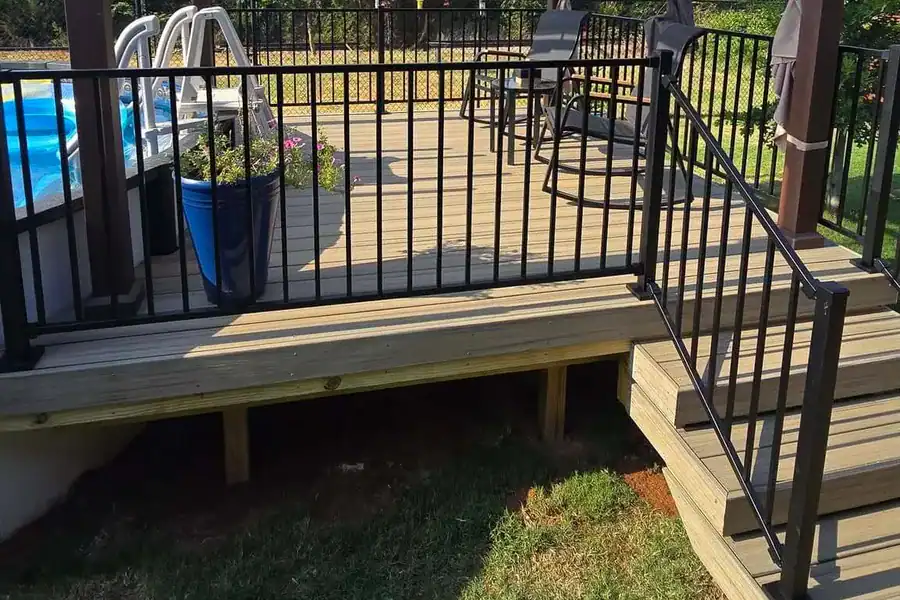
Aluminum has limits, too. It costs more up front than a basic wood railing, a powder-coated finish can chip if it takes a hard hit, and hollow aluminum sections feel lighter under your hand than a solid wood rail. For homeowners who want metal deck railings without the rust watch that comes with steel or wrought iron, it’s still one of the most practical choices.
Composite Deck Railings: The Look of Wood With Less Work
Composite deck railings suit homeowners who like the appearance of wood but not the staining schedule. Composite railing is typically made from a blend of wood fibers and plastics, and many systems add a protective outer cap that helps resist fading and moisture. It doesn’t need staining or painting, and occasional cleaning with soap and water keeps it looking sharp.
The limitations are worth knowing before you buy. Composite costs more than wood up front, the profiles tend to be chunkier than metal, and you can’t sand and restain it if you want a different color in ten years. Dark colors also get warm in direct summer sun, as anyone who has grabbed a car door handle in August can confirm.
A composite deck with a matching railing gives you a polished, coordinated look, but matching everything isn’t your only option. Dark railing posts against lighter decking add contrast, and a composite top rail over black metal balusters adds a custom touch without much extra cost. If you’re still deciding on the deck boards themselves, our comparison of composite decking vs. wood decking covers the same trade-offs underfoot.
Vinyl Railing: Low Upkeep With a Bulkier Profile
Vinyl railing is made from PVC and sits alongside composite as one of the lowest-maintenance options on the market. It’s lightweight, it won’t rot or need paint, and a rinse with soap and water handles most cleanups. Many vinyl systems hide aluminum or steel reinforcement inside the rails and posts to give them the strength a guard needs.
The main drawback is appearance. Vinyl rails and posts tend to look bulkier than metal and more uniform than wood, and color choices are usually limited to whites, tans, and a few wood-look shades. Quality also varies a lot between product lines, so it pays to look at the reinforcement and the warranty before you choose a system.
Cable Railing: Clean Lines and Open Views
When your deck overlooks a pond, a wooded lot or a wide-open Oklahoma sunset, cable railing lets the scenery take center stage. Instead of traditional balusters, a cable railing system runs thin stainless steel cables between structural posts. The result is a minimalist design that keeps sightlines open while still giving you a safety barrier.
Cable railing fits modern homes best, though stainless cables on wood posts make a warm, contemporary pairing. It’s also among the more expensive options, and it asks more of the frame because the end posts carry the combined tension of every cable in the run. Wind passes straight through the cables, so cable infill catches far less wind than solid glass or vinyl panels.
The cables do give a little when someone leans or pushes on them, and that’s why tension matters. A cable that loosens over time can spread far enough to open a gap wider than the 4-inch limit, so plan on checking the tension now and then and wiping the stainless down after dusty spells.
Glass Railing: An Unobstructed View of the Backyard
If cable railing keeps views open, glass railing goes a step further. Glass panels give you a nearly uninterrupted look at the yard while forming a solid barrier along the deck’s edge, and they also cut the wind on an exposed, raised deck. That same quality means they block a pleasant breeze in July, which is worth thinking about before you commit.
Frameless glass uses minimal hardware for a nearly invisible barrier, while framed systems hold the glass panels between vertical posts and a top rail. Framed versions suit a wider range of deck styles and usually cost less than frameless. Either type needs safety glazing, engineered supports, and careful installation to maintain its structural integrity.
Glass is typically the most expensive railing material, and it has one unavoidable chore: fingerprints, dust, and water spots. If you’ve ever cleaned a sliding glass door, you already know the drill. For a deck where an unobstructed view is the whole point, plenty of homeowners decide that’s a fair trade.
Metal Deck Railings: Wrought Iron, Steel and Decorative Balusters
Not every metal railing has to look modern. Wrought iron and decorative steel balusters bring a traditional look to decks, porches and outdoor stairways, and they’re a natural fit for a Victorian home or any house with classic trim details. Curved elements, scrolls, and patterned infill options give you character that flat pickets can’t.
Metal balusters also pair well with wood posts and rails, which gives you the warmth of wood with slimmer, cleaner infill. The catch with iron and steel is corrosion. A powder-coated finish or good paint protects the metal, but any scratch that reaches bare steel needs a touch-up before rust spreads, so they aren’t the pick for anyone who wants to forget the railing exists.
Creative Deck Railing Designs to Match Your Deck Style
Your railing doesn’t have to match the one next door. A few thoughtful choices can give your outdoor living space its own personality and a little extra curb appeal without turning the project into an architectural experiment. Here are three deck railing designs we see work well on Oklahoma homes.
Mix Wood Posts With Metal Balusters
Wood and metal make a good team. Wood posts and a wood top rail supply the warmth, while slim black metal balusters add contrast and open up the view compared with thick wood pickets. This combination works on traditional homes, modern farmhouses, and rustic cabins alike, and it’s a practical way to update an older deck while keeping a familiar style.
Add a Cocktail Rail for Extra Function
A cocktail rail is a wide, flat top rail, often a deck board laid flat, that gives you a spot for a glass or a plate. It’s a small upgrade that earns its keep at every cookout. The rail still has to meet the same height and strength rules as any other guard, and a board laid flat needs to shed water so it doesn’t cup.
Use Color and Baluster Patterns for Visual Interest
Sometimes the simplest changes do the most. Black vertical balusters against natural wood give a timeless contrast, white composite railing brightens a traditional porch, and textured black aluminum adds definition to a modern deck. Decorative infill options, turned balusters, and contrasting post caps are all on the table, as long as the details complement your home’s architecture and don’t compete with it.
Which Deck Railing Materials Handle Oklahoma Weather Best?
Oklahoma doesn’t go easy on outdoor structures. Between hot summers, strong winds, sudden thunderstorms and the occasional ice storm, railing materials have plenty to deal with, and no material shrugs off all of it. What changes from one material to the next is the kind of attention it needs. Here’s what we tell homeowners about each one:
- Aluminum won’t rust and doesn’t need painting, but check the finish for chips after hail.
- Composite resists moisture and rot, though dark colors run hot in full sun.
- Vinyl won’t rot or need paint, and the reinforced systems hold up best.
- Wood holds up well when it’s sealed on schedule and suffers quickly when it isn’t.
- Cable and glass depend heavily on strong posts and solid connections, especially in wind.
- Iron and steel are strong but need their coating kept intact.
Whichever material you choose, installation matters as much as the product. A railing is only as strong as the posts and the framing they’re fastened to, which is why we look at the structure of the deck before we talk about railing styles.
Deck Railing Safety and Local Building Codes
A deck railing is a safety feature first and a design feature second, particularly on a raised deck. Building codes call the protective railing a guard, and the rules for it are specific. Oklahoma’s statewide residential code is the 2018 International Residential Code, according to the American Wood Council’s Oklahoma code summary, though cities adopt and enforce their own versions.
Under the IRC, a guard is required when the deck’s walking surface is more than 30 inches above the ground; the guard must be at least 36 inches high on a residential deck, and balusters must be spaced so a 4-inch sphere can’t pass through. That 4-inch rule applies under the bottom rail too, so the gap between the deck surface and the bottom rail has to stay under 4 inches. Simpson Strong-Tie’s engineers summarize these requirements in their guide to deck guardrails, and local building codes may add to them, so confirm the rules with your city’s permit office before you build.
Guards also have to be strong. Table R301.5 of the IRC requires the top of a guard to resist a 200-pound concentrated load applied in any direction at any point, and the infill, meaning the balusters or panels, to resist 50 pounds applied over one square foot. That’s where many do-it-yourself railings fall short.
The usual weak point is the post connection, where a couple of lag screws into the rim board aren’t enough. Proper post anchoring, secure top and bottom rails, and solid blocking in the deck frame are what keep a railing from wobbling a year later.
Easy Installation vs. Professional Deck Railing Installation
Some railing systems are sold as easy to install, especially aluminum and composite kits with pre-assembled panels and simple brackets. On a low deck with a square layout, a handy homeowner can get a good result. There’s a real difference, though, between attaching a panel and building a railing system that holds up when someone leans on it.
Posts have to tie into the deck’s framing, stair sections have to be cut to the right angle, and the finished guard has to meet local code requirements. Cable systems need the right tension, and glass panels are heavy and unforgiving to handle. That’s why raised decks, stairs, complex layouts and specialty materials are the jobs where our in-house crews make the biggest difference.
How to Choose the Right Railing for Your Deck Project
With this many railing styles on the market, the choice comes down to balancing appearance, maintenance, budget, and how you use the deck. It helps to work through a few questions before you look at samples. Start with these:
- What matches your home? Traditional wood, decorative metal, and modern glass or cable each suit different houses.
- How much maintenance will you really do? Wood needs regular care, while aluminum, composite, and vinyl need little upkeep.
- Do you want an open view? Cable and glass keep sightlines clear, and slim metal balusters come close for less money.
- What’s your budget? Wood costs the least up front, and glass and cable sit at the top.
- Who uses the deck? Kids, pets, and frequent guests all affect the height, spacing, and style that make sense.
Your answers usually narrow the field to one or two materials. From there, you can browse our deck railing options to see the wood, aluminum, composite, and cable railings we install, including Trex railing lines that pair with Trex composite decks. A unique deck railing idea is only worth building if it suits your home and performs safely.
Deck Railing FAQs
These are the railing questions we hear most often from Oklahoma homeowners. The short answers below will get you started, and we’re happy to go deeper on site.
What Is the Cheapest Way to Do Deck Railing?
A pressure-treated wood railing with simple vertical balusters is usually the cheapest upfront option. The materials are inexpensive and the construction is simple, which keeps labor down. Keep in mind that wood needs the most upkeep over time, so the cheapest railing to build isn’t always the cheapest one to own.
What Is the Best Type of Railing for a Deck?
There isn’t one best type, because it depends on what you value most. Aluminum and composite are strong picks when you want low maintenance, wood wins on starting cost and traditional charm, and cable or glass is best when the view matters most. For most Oklahoma backyards, we find the decision comes down to wood versus aluminum or composite.
What Can I Use Instead of a Deck Railing?
On a low deck where the code doesn’t require a guard, you can define the edge with built-in benches, planter boxes or wide wraparound steps. These keep the deck feeling open while still marking where it ends. Once the walking surface is more than 30 inches above the ground, a code-compliant guard is required, and nothing else substitutes for it.
What Are Some Modern Deck Railing Ideas?
Popular modern looks include horizontal cable railing, glass panels, textured black aluminum, and wood posts with slim black metal balusters. Mixing materials is common, such as a flat cocktail rail over metal infill. Simple lines and dark, thin infill are what make a railing read as modern.
What Is the Easiest Deck Railing to Install?
Railing kits with pre-assembled panels, usually aluminum or composite, are the easiest to install because the baluster spacing is already set. A basic wood railing is also simple to frame for anyone comfortable with a saw and a level. Cable and glass are the hardest, and they’re the ones we’d most recommend leaving to our crews.
Bring Your Deck Railing Ideas to Life With Tiller Fence and Deck
A good deck deserves a railing that’s as solid as it looks. Tiller Fence and Deck builds decks and railings with our own in-house crews. We’re licensed and insured, and we back our work with a one-year workmanship guarantee. That means the people who set your posts are the same people who answer for how they hold up.
If you’re not sure which railing materials or styles fit your home, we’ll come out, look at your deck, and talk through the choices and the budget with you. Contact Tiller Fence and Deck to schedule a free on-site estimate. We’d be glad to give your deck a railing worth leaning on.